
A Guide to Probes and Dopplers
- Sales Team
- Canonbury
- 12 Jan 2026 views
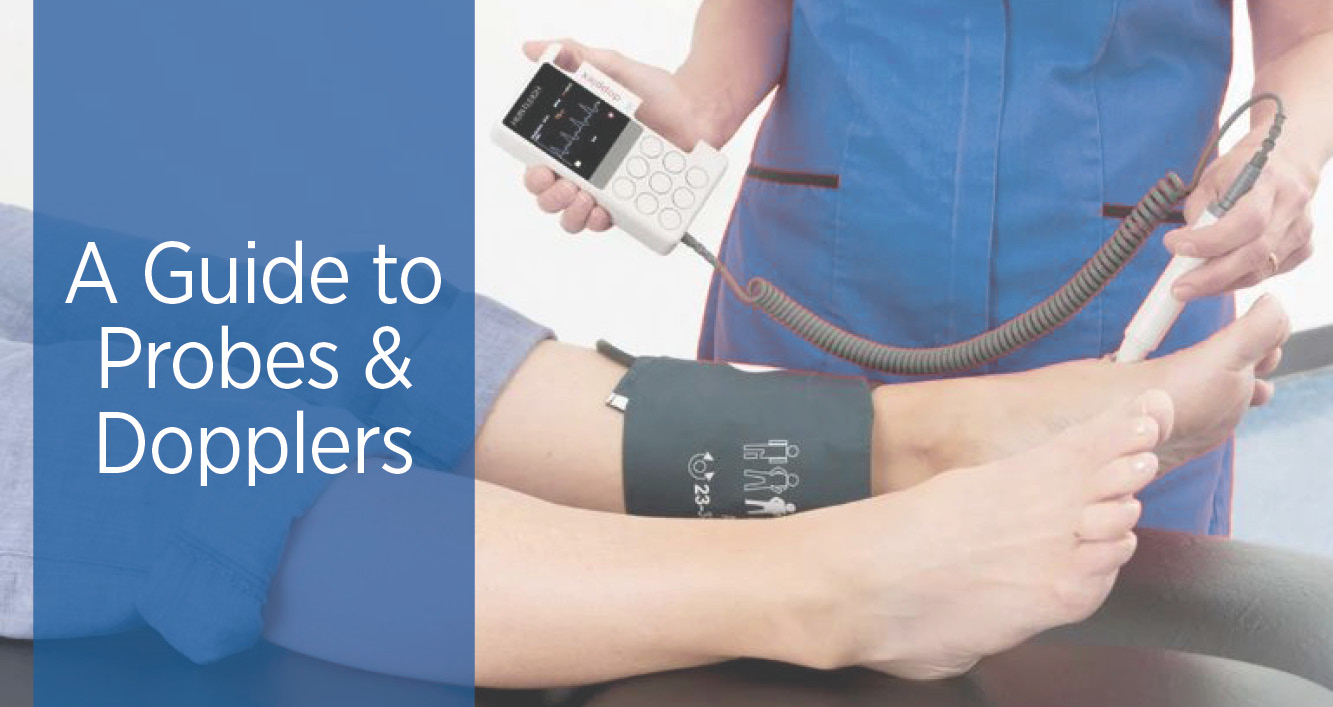
A Guide to Podiatry Probes & Dopplers
Vascular assessment is a fundamental part of modern podiatric practice. Conditions such as peripheral arterial disease, diabetes-related complications, and non-healing wounds all require accurate evaluation of blood flow to the lower limb. Handheld Doppler ultrasound devices, together with the correct probes, allow podiatrists to assess circulation quickly, non-invasively, and at the point of care.
This guide is designed to provide a clear and practical overview of podiatry probes and Dopplers. It is suitable for practicing podiatrists, students, and clinics looking to understand how Dopplers work, how to use them effectively, and how to choose the right equipment for their clinical needs.
What is a Podiatry Doppler?
A Doppler ultrasound device uses high-frequency sound waves to detect blood flow within vessels. When the sound waves encounter moving red blood cells, their frequency changes. This change is translated into an audible signal or visual waveform that reflects the speed and pattern of blood flow.
In podiatry, handheld continuous-wave Dopplers are most commonly used. These devices are portable, easy to operate, and ideal for routine vascular screening in clinical environments. Unlike imaging ultrasound, handheld Dopplers focus on detecting flow rather than producing anatomical images.
What Conditions do Dopplers and Probes Help Diagnose?
Doppler assessment plays a vital role in many areas of podiatric care, including:
-
Screening for peripheral arterial disease (PAD)
-
Assessing vascular status in patients with diabetes
-
Evaluating wound healing potential
-
Monitoring circulation before and after treatment
-
Supporting referral decisions for further vascular investigation
Regular use of Doppler assessment improves clinical decision-making and enhances patient safety.
Understanding Podiatry Doppler Probes
What is a Doppler Probe?
The Doppler probe is the handheld component that transmits and receives ultrasound signals. It connects to the Doppler unit and is applied directly to the patient’s skin using ultrasound gel. The probe’s design and frequency determine how deeply the sound waves penetrate and how clearly blood flow can be detected.
Selecting the correct probe is just as important as choosing the Doppler unit itself. An inappropriate probe frequency or design can lead to poor signal quality and inaccurate assessment.
Common Probe Frequencies
Different probe frequencies are used depending on vessel depth and patient characteristics:
-
8 MHz probes are the most commonly used in podiatry and are suitable for general vascular assessment of pedal arteries.
-
10 MHz probes provide higher resolution for superficial vessels and are useful in thinner patients or when assessing shallow arteries.
-
5 MHz probes penetrate deeper tissue and are helpful in patients with edema, obesity, or deeper vessel anatomy.
Lower frequencies penetrate deeper but offer less resolution, while higher frequencies provide clearer signals at shallower depths.
Choosing the Right Doppler and Probe for your Practice
When selecting a Doppler Probe consider these key factors:
- Your primary clinical focus (routine screening, wound care, high risk foot clinics)
- Patient demography and common comorbidities
- Required probe frequencies
- Portability and durability of the device
- Ease of use and any training requirements
A general purpose doppler with an 8MHz probe is is suitable for most podiatry practices, with additional probes added as clinical requirements expand.
How to use a Doppler Probe Correctly
Best Practice Technique
Accurate doppler assessment relies on using the correct technique:
- Position the patient comfortably, ideally supine
- Apply ultrasound gel to reduce air interference
- Hold the probe at a 45-60 degree angle to blood flow
- Use light pressure to avoid compressing the vessel
- Move slowly to locate the strongest signal
Interpreting Doppler Signals
The different doppler sounds provide important information about arterial health:
- Triphasic Signals - indicate healthy arterial flow
- Biphasic Signals - May suggest mild diesese or age related changes
- Monophasic Signals - Often indicate significant arterial compromise
Abnormal findings should be documented and may warrant referral for further vascular assessment.
Common Mistakes and Troubleshooting
Common issues during doppler assessment include:
- Applying excessive pressure and occluding blood flow
- Incorrect probe angle
- Using the wrong probe frequency
- Insufficient gel leading to signal loss
If signals are difficult to locate, reassess positioning, reduce pressure and consider switching probe frequencies.
Maintenance, Care and Calibration
Regular maintenance extends the lifespan of doppler equipment and ensures accurate readings:
- Clean probes after each use according to manufacturer guidelines
- Avoid excessive bending or pulling of probe cables
- Store equipment in a protective case
- Schedule routine servicing and calibration as reccomended
Podiatry Dopplers and Probes from Canonbury
UltraTec PDcv1 Pocket Vascular Doppler with 8MHz Probe
The UltraTec PD1cv is a small, lightweight, high sensitivity pocket Doppler with fixed vascular probes.
Huntleigh DMXR Rechargable Digital Doppler
Desgned to improve efficiency and effectiveness in the clinical diagnosis, rechargeable via usb interface.
UltraTec PD1 Combi Pocket Vascular Doppler with 8MHz Probe
Comes with 8MHz probe as standard but can be fitted with 5MHz probe also.
Huntleigh DMX offers unrivalled value and quality, with visual confirmation of sound providing additional clinical significance.
FAQ's
Are Podiatry Dopplers and Probes Sold Seperately?
At Canonbury we offer Doppler and Probe kits such as the UltraTec Doppler with Probe
We also sell Probes seperately such as the Huntleigh DPX Probe
You can shop our full range of probes and dopplers here
Do Canonbury Sell Probes of Other Frequencies or Only 8MHz?
We also sell a 5MHz probe from UltraTec
Many dopplers support different probe frequencies but always check manufacturer guidelines before making the right choice for your practice.
Posts