
What is a Biometrics assessment in Podiatry?
- Sales Team
- Canonbury
- 25 Mar 2026 views
What is a Biomechanics Assessment in Podiatry?
Biomechanics sits at the core of effective podiatry care. Every step a patient takes relies on a coordinated reaction between joints, muscles, tendons and external forces. When that system is even slightly off, it rarely stays contained. Pain, dysfunction and longer term complications tend to follow.
A biometrics assessment is a clinical process used to understand how and why those disruptions occur. It moves beyond surface level symptoms and provides structured, measurable insight into movement patterns, loading forces and structural allignment.
For clinicians, this goes beyond observation and becomes a mechanism for thinking through a problem. The findngs directly inform treatment decisions, whether that is orthotic prescription, offloading or rehabilitation. Increasingly, the quality of these decisions is shaped not only by clinical experience, but also by access to reliable diagnostic tools and treatment equipment, an area where suppliers like Canonbury play an supporting role.
What is a biomechanics?
Biomechanics is the study of how the body moves, with particular focus on the forces acting on the muscles, joints and skeletal structures.
In podiatry this centres on how the foot functions within the wider kinetic chain. The foot does not work in isolation, it both influences and responds to what happens at the ankle, knee, hip and even the lower back.
When a patient walks or runs, several systems work together:
- Joints provide range and positioning
- Muscles generate movement and stability
- Tendons transfer force
- The foot acts as both a shock absorber and a propulsive lever
Even small inefficiencies can shift how a load is distributed. Over time, the body adapts.
However, those adaptations are not always helpful, and often show up as pain somewhere else entirely. This is why biomechanics plays a central role in clinical decision making, with NHS portals highlighting biomechanical assessment as a core method for guiding diagnosis and treatment planning.
What is a biomechanics assessment in podiatry?
A biomechanics assessment is a structured clinical evaluation of how a patient moves and how forces are distributed through the lower limb.
It's purpose is twofold:
- To support accurate diagnosis of musculoskeletal and foot related conditions
- To guide targeted, evidence based treatment planning
Rather than focussing solely on symptoms, the assessment identifies root mehanical causes. For example, plantar heel pain may stem from abnormal pronation, reduced ankle dorsiflextion or altered gait timing.
For clinicians, this means the treatment becomes proactive rather than reactive. Instead of managing pain in isolation, interventions are designed to correct or compensate for the underlying mechanical dysfunction.
What clinicians evaluate during a biomechanical assessment
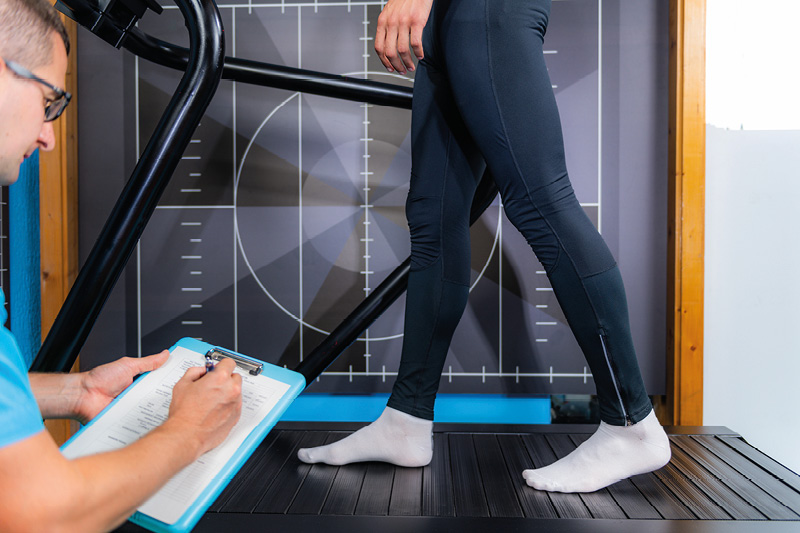
A biomechnics assessment is best understood through the key areas clinicians evaluate to build a complete picture of patient function.
This begins with gait analysis, where walking or running patterns are are obseved to identify asymmetries, timing issues, and deviations in movement. Depending on the clinical set up, this may be visual or supported by diagnostic systems that provide more detailed insight into stride and loading characteristics.
Alongside this, postural assessment provides a static reference point. Clincians assess alignment, including foot position and limb orientation, to identify structural imbalances and how weight is distributed at rest.
Joint range of motion, is then evaluated, particularly at the ankle, subtalar joint, and first metatarsophalangeal joint. Restrictions of excessive mobility in these areas can significantly influence fuction and compensation patterns.
Additionally, pressure distribution looks at how forces are applied across the foot. Where available, pressure mapping can highlight areas of overload associated with pain, callus formation, or increased ulceration risk.
Finally, footwear evaluation considers how external factors contribute to or mitigate biomechanical issues. Wear patterns, fit, and appropriateness for activty all inform clinical decision making.
In practice, these insights are often enhanced by diagnostic technologies and supported by podiatry tools, from appliance modification equipment to scanning systems used in orthotic design.
What conditions can a biomechanical assessment help with
A biomechanics assessment has broad clinical application across both acute and chronic presentations. Rather than treating symptoms in isolation, it helps identify the mechanical drivers behind them.
Common conditions include:
- Plantar fasciitis
- Flat feet and high arches
- Heel pain
- Knee, hip, and lower back pain
- Sports injuries
In each case, symptoms are often driven by abnormal loading patterns, structural variation, or compensatory movement elsewhere in the kinetic chain. A biomechanics assessment enables clinicians to differentiate between these factors, supporting more precise and effective intervention.
For clinicians and clinic owners, this breadth of application reinforces the value of integrating biomechanics into routine assessment protocols, supported by the right combination of diagnostic tools and treatment materials.
Why biomechanics matters in foot health
The foot and ankle comprise 26 bones, 33 joints, and over 100 muscles, tendons, and ligaments, forming a system responsible for stability, shock absorption, and propulsion during gait. Small deviations in alignment or joint function can alter load distribution, increasing stress on specific tissues over time.
These altered loading patterns are a key contributor to conditions such as plantar fasciopathy, tendinopathy, and joint degeneration. In many cases, the presenting symptom reflects sustained mechanical overload rather than isolated pathology.
Biometrics provides a key framework for analysing how forces are generated and transferred during movement enabling clinicians to identify the source of dysfunction and guide intervention more precisely.
A strong biomechanical approach delivers measurable value:
- Pain reduction - Through targeted, load-based intervention
- Injury prevention - by identifying abnormal stress patterns early
- Improved mobility and performance - particularly in active patients
- Long term tissue resilience, reducing recurrence and chronic overload
For practices, this also supports more consistent outcomes and strengthens clinical credibility.
How biomechanical findings influence treatment
The value of a biomechanical assessment lies in how findings translate into targeted intervention. Identifying how forces are distributed, where motion is restricted, and how gait is altered allows clinicians to select treatments that directly address the underlying mechanical cause.
- Custom orthotics to control or redistribute load based on individual biomechanics
- Prefabricated insoles where appropriate, offering scaleable support aligned to patient need
- Offloading techniques including padding, gels and pressure redistribution strategies
- Footwear modification to improve stability, fit, and functional performance
- Strengthening and rehabilitation programmes to address muscular control and movement efficiency
These interventions are often informed by objective data and refined through clinical adjustment . In pratice, this relies on the ability to both assess and modfy treatment effectively, using diagnostic tools such as pressure analysis systems, dopplers where indicated and podiatry drills or grinding equipment for orthotic adjustment and appliance modification.
Who Needs a Biometrics Assessment
Biomechanical assessment is most useful where mechanical loading is likely to influence symptoms or outcomes.
This includes high-risk patients, such as those with diabetic foot concerns, where pressure distribution must be managed carefully. It is also relevant for athletes and high-load individuals, where repetitive stress increases the impact of small mechanical inefficiencies.
Patients with recurring musculoskeletal issues may require assessment to identify underlying causes, while in post-injury rehabilitation it helps guide a safe and effective return to function.
Conclusion
Biomechanics underpins how clinicians assess and manage foot and lower limb conditions. A structured assessment provides insight into how movement and load interact, allowing treatment to be guided by measurable findings rather than symptoms alone.
This supports more precise use of orthotics, insoles, offloading techniques, and rehabilitation strategies, leading to more consistent clinical outcomes.
Next Steps for your Clinic
If you are reviewing your current approach to biomechanics, or looking to strengthen how you assess and treat patients, it can be useful to take a step back and look at what is working and where there may be gaps.
If you would like to discuss your current setup, or explore practical ways to support your clinical approach, feel free to get in touch.
Posts